CA License #0L75450  ·  Independent brokerage, 20+ years, quoting the CEA and private carriers CA License #0L75450 quote@cheapearthquakeinsurance.com
Commercial earthquake insurance

Your property policy excludes the one peril California is famous for.

Every commercial property policy written in California excludes earthquake. The building, the tenant improvements, the inventory and the income the property produces are all uncovered for the shaking. Commercial earthquake insurance is a separate purchase, and for a growing share of buildings the lender requires it. We place it in the admitted and surplus markets, sized to your PML and the loan covenant, not past it.

Send the address, values, year built, construction type, any PML report and the lender's requirement. We quote the market and structure to the covenant.

Collapsed brick storefront in downtown Santa Cruz behind caution tape after the 1989 Loma Prieta earthquake
Downtown Santa Cruz, 17 October 1989. Magnitude 6.9. The building's property policy paid nothing for this.
Admitted and surplus markets on one submissionLoss limits sized to PMLBusiness interruption placed with the buildingRetail, industrial, office, multifamily, HOA
Who buys it

Four owners, four different reasons.

Owners with debt

Many commercial lenders, especially on larger loans, CMBS loans and loans on older buildings, require earthquake insurance as a loan covenant. Some tie the requirement to the building's PML score. If you are refinancing this year, expect the question.

Owners without debt

No lender to force the issue, just the math. A free-and-clear building is concentrated equity sitting on California soil. The owners who buy voluntarily are the ones who have worked out what a red-tagged building does to the balance sheet and to the tenants' leases.

Tenants

The landlord's earthquake policy, if there is one, covers the building. It does not cover your improvements, equipment, inventory or the income you lose while the space is unusable. Businesses with a significant build-out in an older building carry real, uninsured exposure and usually do not know it.

HOAs and mixed-use

Commercial-scale placements for associations are their own specialty. When an association goes bare, the loss-assessment exposure lands on every unit owner. We write the master policy and the unit-owner side.

What a placement includes

Five parts. The one people skip is the one that keeps the loan paid.

  • Building: repair or reconstruction of the structure.
  • Business personal property: equipment, inventory, furniture, tenant improvements and betterments.
  • Business interruption and rental income: the coverage that keeps the loan paid and the business alive while the building is repaired. Often the most valuable piece, and the most commonly left out.
  • Ordinance or law: the cost of bringing a damaged older building up to current code during repairs. In California this can rival the direct damage.
  • Earthquake sprinkler leakage: sometimes written as a separate, cheaper endorsement when full earthquake coverage is not purchased.

Deductibles are percentage-based, typically 5% to 25% of the covered values, and apply per unit of coverage. Larger schedules are commonly placed in layers or shared among carriers.

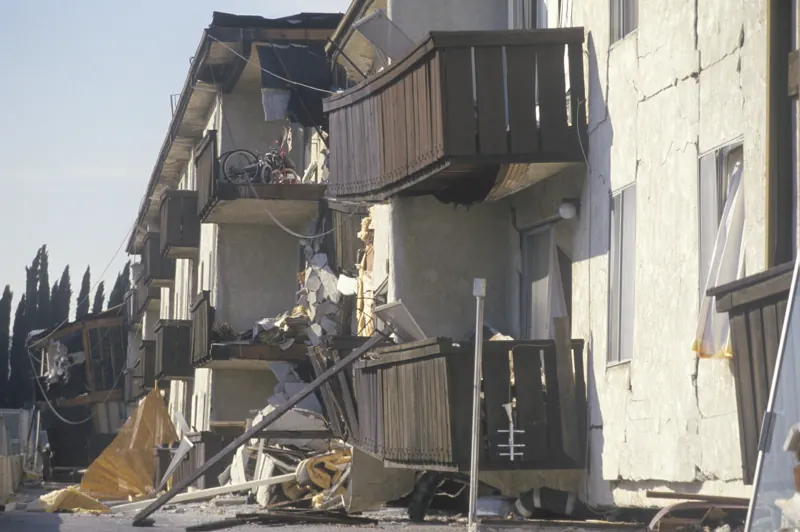
A multi-storey apartment building with its ground floor crushed and upper balconies collapsed after an earthquake
A soft-story apartment building. Rent stops the day the placard goes up, which is what the business interruption line is for.
The number that drives the quote

PML: what a major quake would take from the building, as a percentage.

Probable Maximum Loss is an engineering estimate of the share of the building's value a major earthquake would destroy. Underwriters and lenders read it the way a bank reads a credit score.

1

Construction and era dominate

Post-1994 steel or wood-frame buildings score well. Tilt-ups with unretrofitted roof-to-wall connections, non-ductile concrete and unreinforced masonry score badly, sometimes uninsurably at standard terms.

2

Soft-story buildings score high until retrofitted

Retail or parking at ground level with rigid floors above. Los Angeles, San Francisco and other cities now mandate the retrofit. A completed, documented retrofit is one of the few actions that directly cuts both the premium and the deductible options available.

3

Soil and site matter

Two identical buildings, one on rock and one on fill, can quote very differently. The address is part of the risk.

If your lender ordered a PML report, send it to us with the loan's insurance language. Many covenants require coverage only when PML exceeds a threshold, commonly around 20%. Quoting to the actual covenant regularly saves owners from buying more than the loan demands.

How to buy it well

Five levers that move a commercial earthquake quote.

Rates are quoted per $100 of covered value and vary widely with construction, location, soil and PML. Rather than a fake precise number, these are the things that control the outcome.

LeverWhat it doesWhat we need from you
Shop admitted and surplusQuotes for the same building genuinely diverge between the two markets. We hold both.Nothing extra. One submission goes to both.
Right-size the limitFull replacement cost is not always the requirement. Loss-limit policies sized to the PML are standard practice and far cheaper than insuring to full value.Building values and the PML report, if one exists.
Choose the deductible with the loan in mindA 5% option can exist at a price. Sometimes a higher deductible with business interruption doing the survival work is the smarter structure.The lender's insurance requirement language.
Document retrofitsPermits and engineering letters for soft-story, tilt-up or bolt-down work move quotes.Permit numbers and the engineer's letter.
Insure the incomeA building that is standing but red-tagged pays no rent. This is where many "cheap" placements turn out expensive.Annual rent roll or business income figure.

Coverage, deductibles and pricing depend on carrier underwriting and the policy issued. Descriptions here are summaries.
Commercial questions

What building owners and tenants ask first.

Deeper reading: Commercial earthquake insurance in California, what building owners and tenants need to know.

Does commercial property insurance cover earthquake damage in California?

No. Standard commercial property policies exclude earthquake damage. Coverage for the building, business personal property, and earthquake-related business interruption requires a separate commercial earthquake policy or endorsement.

When do lenders require commercial earthquake insurance?

Many California commercial loans, especially larger loans, CMBS loans, and loans on older buildings, include earthquake insurance covenants. Requirements are often tied to the building's Probable Maximum Loss, commonly triggered when PML exceeds a threshold around 20%.

What is a PML report?

Probable Maximum Loss is an engineering estimate of the percentage of a building's value that a major earthquake would likely destroy, based on construction type, era, soil and retrofits. Underwriters and lenders use it to set pricing, deductibles, and whether coverage is required at all.

Does a soft-story retrofit lower earthquake insurance costs?

Yes. A completed, documented soft-story retrofit lowers the building's PML, which typically reduces premiums and opens up lower deductible options. Permits and engineering documentation belong in the submission.

Do commercial tenants need their own earthquake coverage?

Usually, if they have meaningful exposure. A landlord's earthquake policy covers the building, not the tenant's improvements, equipment, inventory, or lost income while the space is unusable. Tenant earthquake coverage addresses those gaps.

Quote the market. Structure it to the covenant.

Address, building values, year built and construction, any PML report, and the lender's requirement if there is one. For property, liability and workers' comp, our parent agency Jump Insurance Services handles the full commercial program.

CallGet a Quote